
A High Load Density Miniature Force Sensor for Probing With Robot Feet
Published in IEEE Robotics and Automation Letters(RA-L), 2025
Force sensing on the end effector is crucial for mobile, legged robots to adapt to varying terrain and manipulate objects in complex environments. Since efficient legs have to be light and load bearing, force sensors need to have increased load density while still providing accurate multi-axis forces. Here, we demonstrate a low-cost solution to this problem that integrates four sets of strain gauges, analog-to-digital conversion, and data processing into a single leg of a crab-scale robot. The sensor has a tested range of ±50 N for contact force and ±2.5 Nm for torque, which is more than double the weight of a robot made with six such legs. Then, we demonstrate that our sensor is accurate compared to standard, bulkier force gauges and precise enough to be used to differentiate terrains and even find objects buried in sand. Importantly, the sensor has the greatest force load density of any available sensor and more than twice the torque load density of the next best option. This approach to integrating sensors into the most distal appendages can be applied to many other inexpensive end effectors including robot hands, toes, feet, and other tools.
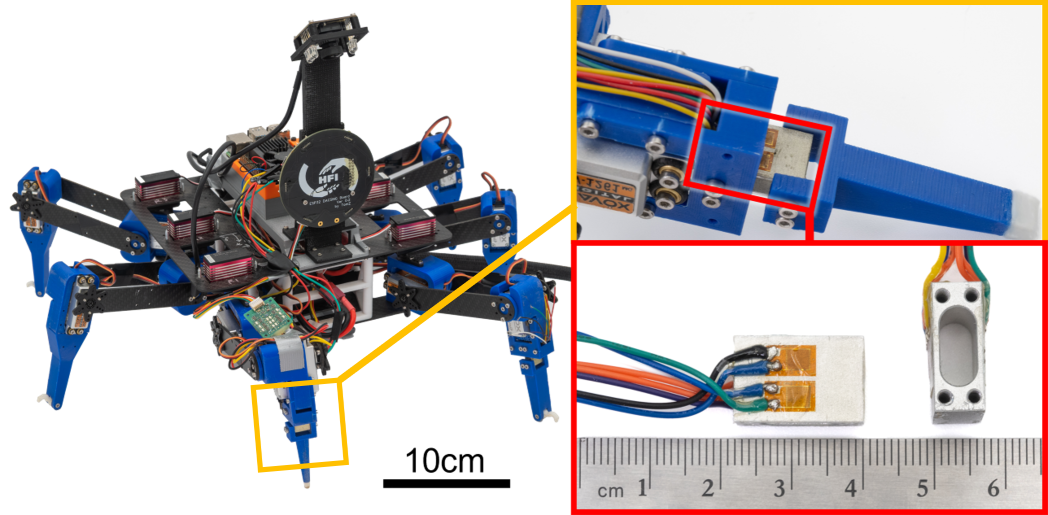
Recommended citation: J. Zhou, J. Su, K. Zuo, M. Pan, Z. Chua and K. A. Daltorio*, "A High Load Density Miniature Force Sensor for Probing With Robot Feet," in IEEE Robotics and Automation Letters, vol. 11, no. 1, pp. 450-457, Jan. 2026.
Download Paper | Download Bibtex