Skip to content

Research & Publications

Publications

Research in robot sensing, soft robotics, and haptic interfaces.

3 publications

Research overview: A Model-Based Visual Contact Localization and Force Sensing System for Compliant Robotic Grippers

IEEE Robotics and Automation Letters · 2026

01

A Model-Based Visual Contact Localization and Force Sensing System for Compliant Robotic Grippers

Kaiwen Zuo, Shuyuan Yang, Zonghe Chua

A model-based visual force sensing system combining contact localization, RGB-D reconstruction, and inverse finite element simulation for compliant grippers.

Abstract

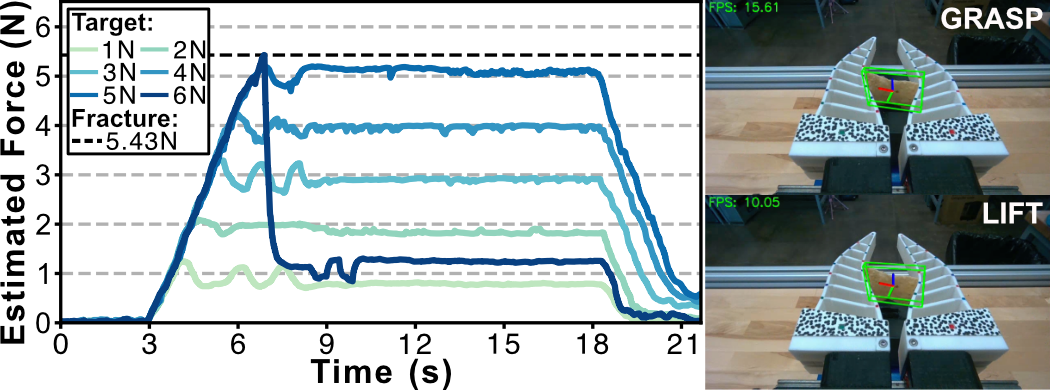
Grasp force estimation can help prevent robots from damaging delicate objects during manipulation and improve learning-based robotic control. Integrating force sensing into deformable grippers requires negotiating trade-offs in cost, complexity, mechanical robustness, and performance. With the growing integration of RGB-D wrist cameras into robotic systems for control purposes, camera-based techniques are a promising solution for indirect visual force estimation. Current approaches mostly utilize end-to-end deep learning, which can be brittle when generalizing to new scenarios, while existing model-based approaches are unsuited to grasping and modern grasper geometries. To address these challenges, we developed a model-based visual force sensing approach integrating an iterative contact localization with generalization to unseen objects. The system extracts structural key points from wrist camera RGB-D images of deforming fin-ray-shaped soft grippers, and uses these key points to define parameters of an inverse finite element analysis simulation in Simulation Open Framework Architecture(SOFA). A mesh reconstruction pipeline and visual iterative contact localization algorithm were developed to dynamically update the contact location in the simulation despite visual occlusion of the contact point for unseen objects. Our system demonstrated an average RMSE of 0.23 N and NRMSD of 2.11% during the load phase, and 0.48 N and 4.34% over the entire grasping process when interacting with different objects under various conditions, showcasing its potential for real-time model-based indirect force sensing of soft grippers.

BibTeX
@ARTICLE{11513996,
  abstract = {Grasp force estimation can help prevent robots from damaging delicate objects during manipulation and improve learning-based robotic control. Integrating force sensing into deformable grippers requires negotiating trade-offs in cost, complexity, mechanical robustness, and performance. With the growing integration of RGB-D wrist cameras into robotic systems for control purposes, camera-based techniques are a promising solution for indirect visual force estimation. Current approaches mostly utilize end-to-end deep learning, which can be brittle when generalizing to new scenarios, while existing model-based approaches are unsuited to grasping and modern grasper geometries. To address these challenges, we developed a model-based visual force sensing approach integrating an iterative contact localization with generalization to unseen objects. The system extracts structural key points from wrist camera RGB-D images of deforming fin-ray-shaped soft grippers, and uses these key points to define parameters of an inverse finite element analysis simulation in Simulation Open Framework Architecture(SOFA). A mesh reconstruction pipeline and visual iterative contact localization algorithm were developed to dynamically update the contact location in the simulation despite visual occlusion of the contact point for unseen objects. Our system demonstrated an average RMSE of 0.23 N and NRMSD of 2.11% during the load phase, and 0.48 N and 4.34% over the entire grasping process when interacting with different objects under various conditions, showcasing its potential for real-time model-based indirect force sensing of soft grippers.},
  month = {jul},
  author = {Zuo, Kaiwen and Yang, Shuyuan and Chua, Zonghe},
  journal = {IEEE Robotics and Automation Letters},
  title = {A Model-Based Visual Contact Localization and Force Sensing System for Compliant Robotic Grippers},
  year = {2026},
  volume = {11},
  number = {7},
  pages = {7788-7795},
  doi = {10.1109/LRA.2026.3692080},
  url = {/files/KZ2026/April_2026_RA_L_Camera_based_force_estimation_final_version.pdf}
}
Research overview: A High Load Density Miniature Force Sensor for Probing With Robot Feet

IEEE Robotics and Automation Letters · 2026

02

A High Load Density Miniature Force Sensor for Probing With Robot Feet

Jianfeng Zhou, Jiaji Su, Kaiwen Zuo, Mingyu Pan, Zonghe Chua, Kathryn A. Daltorio

Force sensing on the end effector is crucial for mobile, legged robots to adapt to varying terrain and manipulate objects in complex environments. In this paper, we demonstrate a low-cost solution to this problem that integrates four sets of strain gauges, analog-to-digital conversion, and data processing into a single leg of a crab-scale robot.

Abstract

Force sensing on the end effector is crucial for mobile, legged robots to adapt to varying terrain and manipulate objects in complex environments. Since efficient legs have to be light and load bearing, force sensors need to have increased load density while still providing accurate multi-axis forces. Here, we demonstrate a low-cost solution to this problem that integrates four sets of strain gauges, analog-to-digital conversion, and data processing into a single leg of a crab-scale robot. The sensor has a tested range of ±50 N for contact force and ±2.5 Nm for torque, which is more than double the weight of a robot made with six such legs. Then, we demonstrate that our sensor is accurate compared to standard, bulkier force gauges and precise enough to be used to differentiate terrains and even find objects buried in sand. Importantly, the sensor has the greatest force load density of any available sensor and more than twice the torque load density of the next best option. This approach to integrating sensors into the most distal appendages can be applied to many other inexpensive end effectors including robot hands, toes, feet, and other tools.

BibTeX
@article{JZ2025,
  abstract = {Force sensing on the end effector is crucial for mobile, legged robots to adapt to varying terrain and manipulate objects in complex environments. Since efficient legs have to be light and load bearing, force sensors need to have increased load density while still providing accurate multi-axis forces. Here, we demonstrate a low-cost solution to this problem that integrates four sets of strain gauges, analog-to-digital conversion, and data processing into a single leg of a crab-scale robot. The sensor has a tested range of ±50 N for contact force and ±2.5 Nm for torque, which is more than double the weight of a robot made with six such legs. Then, we demonstrate that our sensor is accurate compared to standard, bulkier force gauges and precise enough to be used to differentiate terrains and even find objects buried in sand. Importantly, the sensor has the greatest force load density of any available sensor and more than twice the torque load density of the next best option. This approach to integrating sensors into the most distal appendages can be applied to many other inexpensive end effectors including robot hands, toes, feet, and other tools.},
  month = {jan},
  author = {Zhou, Jianfeng and Su, Jiaji and Zuo, Kaiwen and Pan, Mingyu and Chua, Zonghe and Daltorio, Kathryn A.},
  title = {A High Load Density Miniature Force Sensor for Probing With Robot Feet},
  journal = {IEEE Robotics and Automation Letters},
  volume = {11},
  number = {1},
  pages = {450-457},
  ISSN = {2377-3766},
  DOI = {10.1109/lra.2025.3632679},
  year = {2026},
  type = {Journal Article},
  url = {/files/JZ2025/A_High_Load_Density_Miniature_Force_Sensor_for_Probing_With_Robot_Feet.pdf}
}
Research overview: Three Degree-of-Freedom Soft Continuum Kinesthetic Haptic Display for Telemanipulation Via Sensory Substitution at the Finger

2024 IEEE Conference on Telepresence · 2024

03

Three Degree-of-Freedom Soft Continuum Kinesthetic Haptic Display for Telemanipulation Via Sensory Substitution at the Finger

Jiaji Su, Kaiwen Zuo, Zonghe Chua

Sensory substitution is an effective approach for displaying stable haptic feedback to a teleoperator under time delay. In this paper, we present a soft pneumatic handheld kinesthetic feedback device for the index finger that is controlled using a constant curvature kinematic model.

Abstract

Sensory substitution is an effective approach for displaying stable haptic feedback to a teleoperator under time delay. The finger is highly articulated, and can sense movement and force in many directions, making it a promising location for sensory substitution based on kinesthetic feedback. However, existing finger kinesthetic devices either provide only one-degree-of-freedom feedback, are bulky, or have low force output. Soft pneumatic actuators have high power density, making them suitable for realizing high force kinesthetic feedback in a compact form factor. We present a soft pneumatic handheld kinesthetic feedback device for the index finger that is controlled using a constant curvature kinematic model.

BibTeX
@INPROCEEDINGS{10841502,
  abstract = {Sensory substitution is an effective approach for displaying stable haptic feedback to a teleoperator under time delay. The finger is highly articulated, and can sense movement and force in many directions, making it a promising location for sensory substitution based on kinesthetic feedback. However, existing finger kinesthetic devices either provide only one-degree-of-freedom feedback, are bulky, or have low force output. Soft pneumatic actuators have high power density, making them suitable for realizing high force kinesthetic feedback in a compact form factor. We present a soft pneumatic handheld kinesthetic feedback device for the index finger that is controlled using a constant curvature kinematic model.},
  month = {nov},
  author = {Su, Jiaji and Zuo, Kaiwen and Chua, Zonghe},
  booktitle = {2024 IEEE Conference on Telepresence},
  title = {Three Degree-of-Freedom Soft Continuum Kinesthetic Haptic Display for Telemanipulation Via Sensory Substitution at the Finger},
  year = {2024},
  volume = {},
  number = {},
  pages = {79-86},
  doi = {10.1109/Telepresence63209.2024.10841502},
  url = {/files/JS2024/Three_Degree-of-Freedom_Soft_Continuum_Kinesthetic_Haptic_Display_for_Telemanipulation_Via_Sensory_Substitution_at_the_Finger.pdf}
}